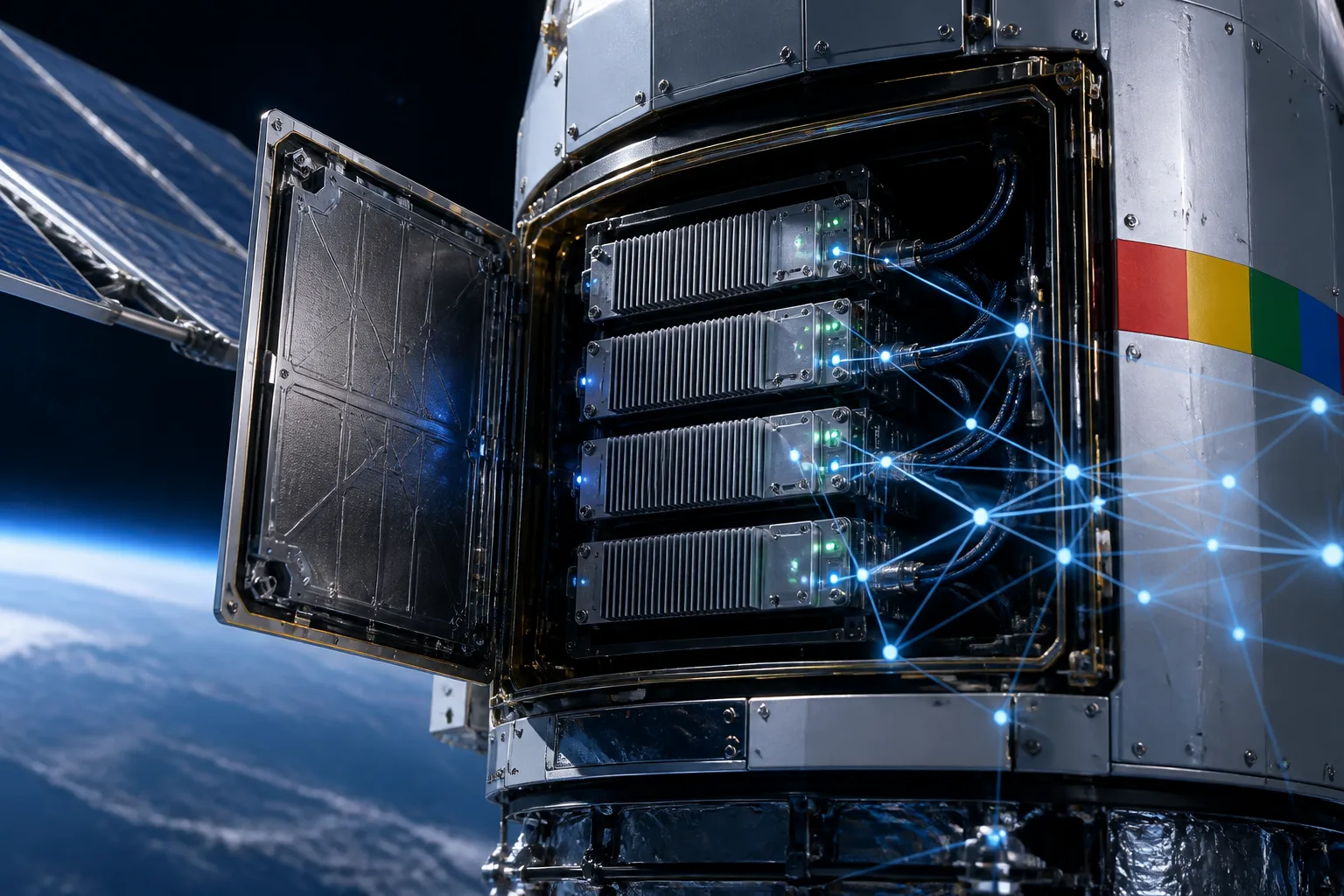
Google’s Suncatcher prototype space data center is online and communicating with the ground after launching earlier this month on a SpaceX Falcon 9 rocket with more than 100 other spacecraft. The small satellite carries four Google Tensor Processing Units (TPUs) and can generate up to 1 kW of electricity, but power limits mean only one TPU can run at a time for about 20 minutes.
Commissioning and initial tests
After roughly three weeks of commissioning to verify subsystems, engineers sent the first prompt to the model pre-loaded on the satellite, Google DeepMind’s Gemma 4. The satellite returned a haiku when asked to write about being in space: “Blue marble below / Data streams in silent grace / Starlight feeds my core.” Google said it also requested the spacecraft report on local orbital conditions and described the satellite as operating nominally.
The ongoing test campaign will examine how the TPUs handle thermal stress and the space radiation environment. Google has already exposed its chips to particle accelerators on Earth, but the company says in-orbit tests are needed to observe real radiation effects. Radiation can cause “bit flips,” which alter stored values in memory and can corrupt data without triggering normal monitoring tools. Ground tests indicated radiation should be less problematic for inference workloads and more of a concern for model training; the flight will allow the team to assess those dynamics directly.
Planned expansion and industry context
If the onboard TPUs perform as hoped, Google plans to launch two additional satellites with advanced chips in 2027. Those follow-on spacecraft are expected to support higher power generation and demonstrate inter-satellite optical links to enable coherent distributed workloads.
Suncatcher’s design emphasizes high-speed links between satellites to share processing, a different approach from some competitors that plan to run inference on individual satellites. The project’s analysis, published by Suncatcher researchers, estimated SpaceX would need about 1,800 Starship flights to achieve the same learning-driven cost reductions seen with earlier vehicles. Both Google and other industry players note that realizing orbital data centers at scale depends on heavy-lift systems such as Starship becoming fully and rapidly reusable.
Alphabet’s recent financial reporting has also highlighted near-term pressures: the parent company’s stock fell this week after noting that moves to integrate AI into search have affected ad revenue growth.
Original source: TechCrunch AI