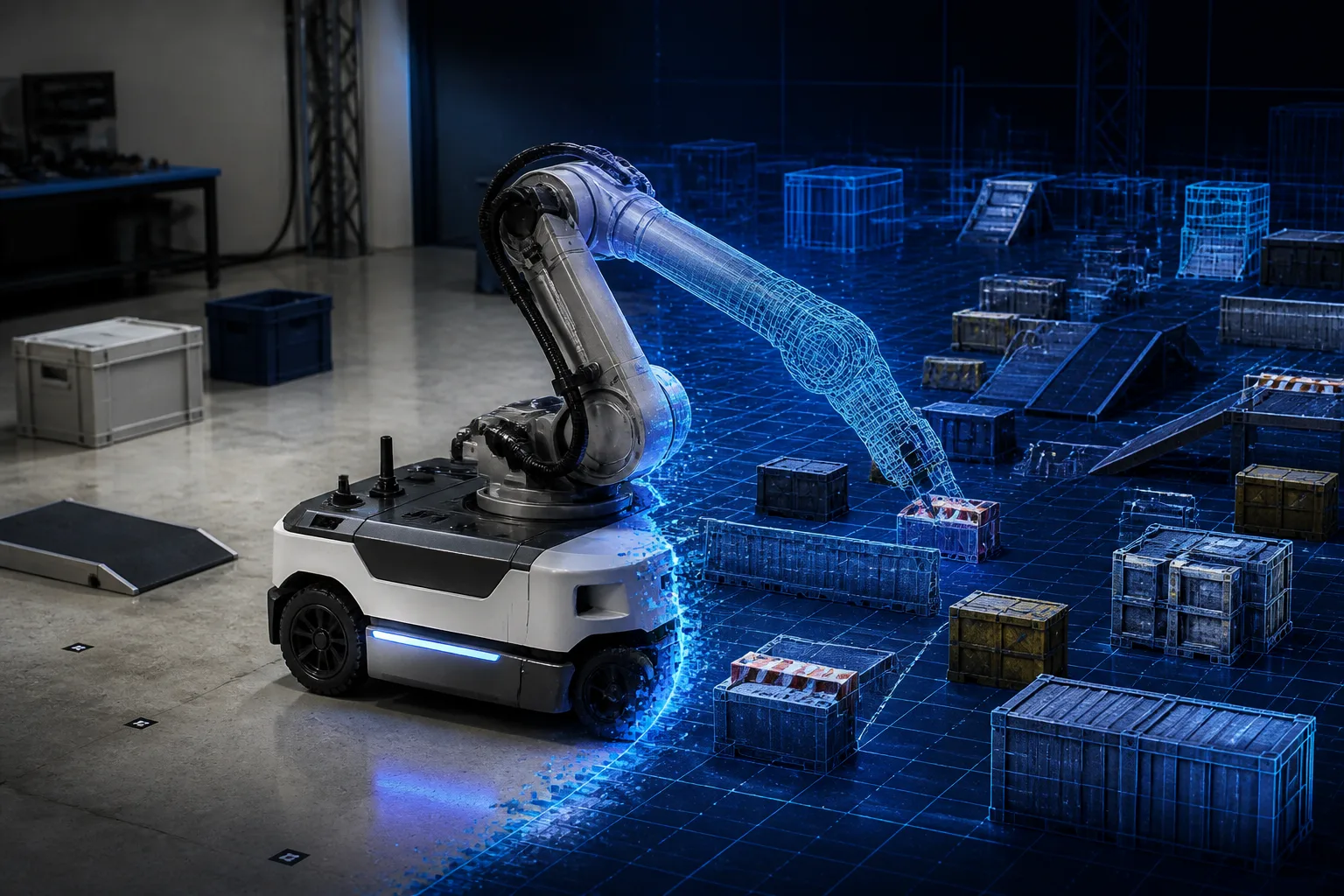
Physicl has raised $10 million in seed funding from Inovia Capital to adapt a 3D-rendering platform for use in robotics training and world-model development. The company says its tools aim to help designers and builders of physical AI create more realistic simulations for model training.
From e-commerce visuals to physical AI
Founder and CEO Alex de Vigan built his previous company, nfinite, around creating 3D product models for online retail. As transformer-based generative models shifted parts of that business toward imagery, de Vigan repurposed the existing technology stack toward rendering environments with accurate geometry, materials and physics. He described the approach as a pipeline that converts “unstructured, incomplete, heterogeneous real-world information into a high-fidelity physical representation” with correct physical properties.
Physicl positions that fidelity as a response to limits researchers have encountered when training robots on video data or collecting costly remote-operation datasets. Simulations are viewed as a possible way to scale training, but developers have struggled to make virtual worlds faithful enough to real-world physics, the company notes.
Studio product and early collaborations
The startup is releasing a product called Studio that includes 10,000 3D environments and 100,000 assets representing a variety of objects. The tool lets users compose scenes to produce synthetic training datasets for specific problems—for instance, helping a robot distinguish a cup on a cluttered countertop or when the cup is in shadow.
SpAItial, a world-model builder, worked with Physicl as an early customer to increase the fidelity of its simulations; its latest product, Echo-3, was released last week. Matthias Niessner, CEO and founder of SpAItial and a professor of robotics at the Technical University of Munich, said SpAItial needed high-fidelity synthetic data for training and found Physicl’s outputs useful. Niessner added that an on-the-fly workflow—where a training system like Claude requests more examples and the platform auto-generates them—was particularly attractive.
Physicl says it intends to serve as an ongoing tooling layer for synthetic data generation and envisions customers bringing large-scale inputs—trillions of images or millions of hours of LIDAR capture—to be converted into high-quality 3D representations and many training permutations. The company will market Studio and the synthetic-data tooling to researchers and robot operators as it begins operations with its new seed financing.
Original source: TechCrunch AI