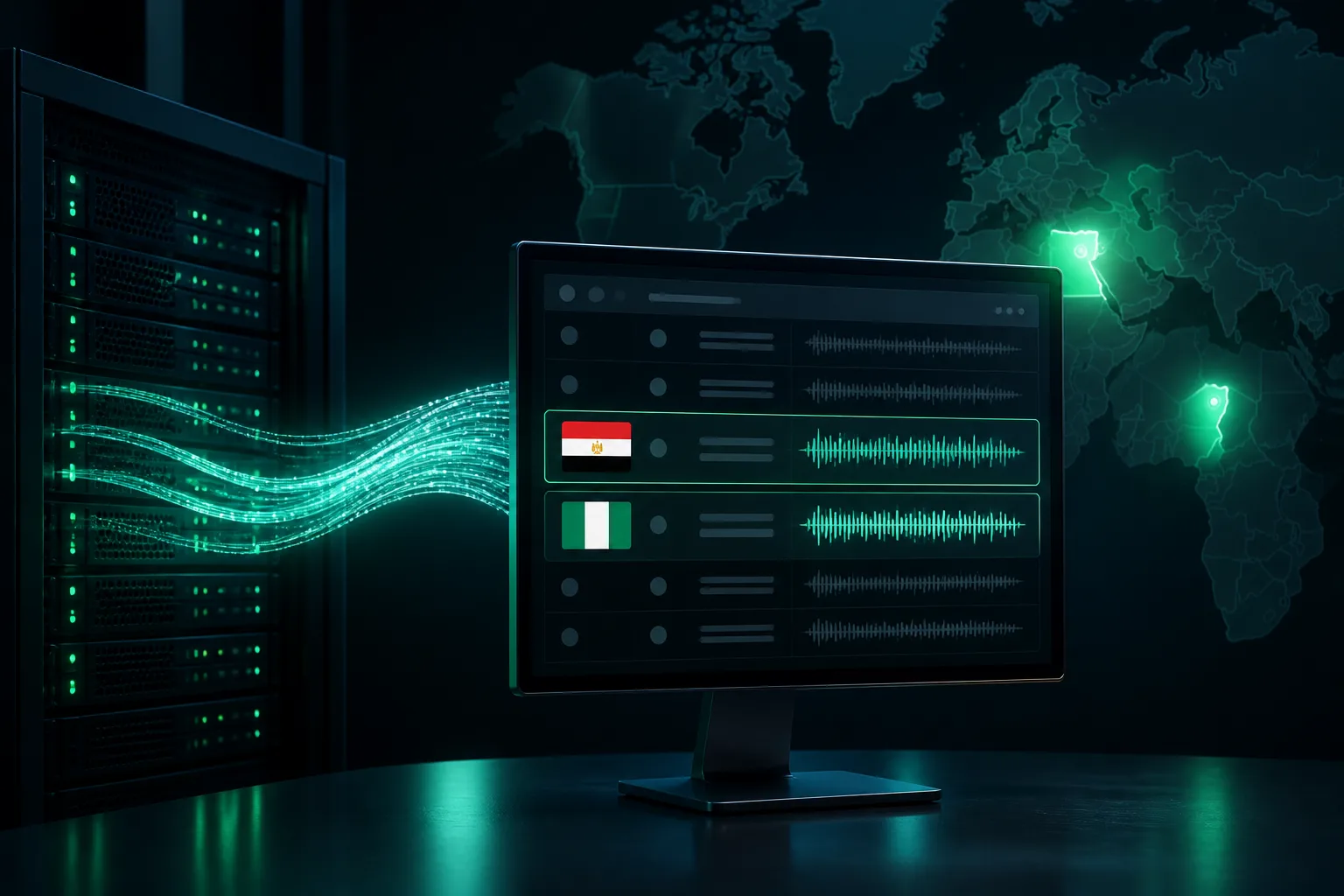
Published November 6, 2026 — The Open ASR Leaderboard announced the addition of private speech data for Egyptian and Nigerian English, supplied by Liva AI. The new splits are intended to extend accent representation in automatic speech recognition (ASR) evaluations and to reduce opportunities for benchmaxxing on public test sets.
New datasets and their characteristics
Two conversational splits were added:
- Liva AI Conversational — Egyptian: 1.34 hours. Conversational, spontaneous; transcriptions are punctuated, cased, and include disfluencies.
- Liva AI Conversational — Nigerian: 1.55 hours. Conversational, spontaneous; transcriptions are punctuated, cased, and include disfluencies.
The announcement notes that these additions follow earlier private data contributions: 11 splits from Appen and DataOceanAI covering scripted and conversational speech across five accents, and a later private split for Indian-accented English with Voice Arena. The project said the community response to prior private held-out sets emphasized the need for trustworthy evaluations.
Accent reporting and provider context
With the new accents, the leaderboard will present a fuller accent breakdown drawing on Kachru’s Three Circles framework. Reporting will include comparisons such as US vs. non-US (UK, Australia, Canada, India, Nigeria, Egypt) and Inner Circle (US, UK, Australia, Canada) vs. Outer & Expanding Circles (India, Nigeria, Egypt). The announcement adds that as more accents are incorporated, the Outer and Expanding Circles will be split further.
About Liva AI: the provider collects multimodal interaction data through consumer products and controls both collection environment and distribution. The project description from Liva AI states this setup allows targeted data collection for specific model gaps and access to natural, high-context behavior emerging from real product use, rather than artificially elicited interactions.
The new Egyptian and Nigerian private splits are available in the leaderboard’s Private tab and are listed with their durations and transcription conventions for evaluation purposes.
Original source: Hugging Face Blog