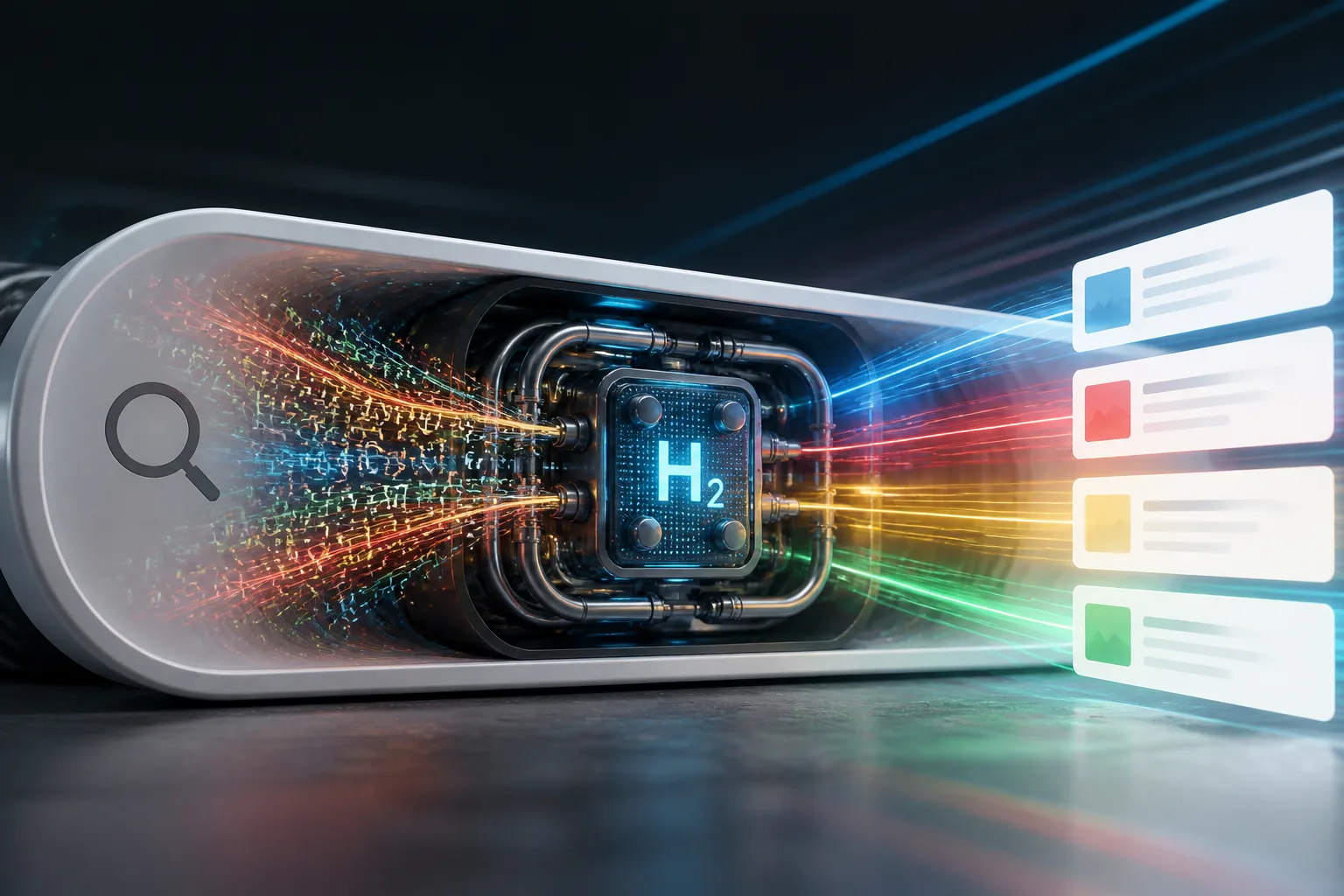
Google is updating Search with Gemini 4 Hydrogen, a new model the company says is tuned for faster execution of multi-step, agentic tasks. Google described Hydrogen as its “biggest model improvement to Search yet,” and positioned it as a balance between speed, cost and capability for everyday workflows.
Model role and measured performance
According to Google, Hydrogen completes tasks 2.5 times faster than Gemini 3.8 Flash. The company also said Hydrogen outperformed Gemini 4 Argon on the Artificial Analysis Intelligence Index at the model’s default high thinking level. For multi-step tasks such as deep research, data analysis and broad codebase navigation, Google noted Hydrogen ranks No. 5 on Agent Arena’s benchmarks.
Google contrasted Hydrogen with its frontier models, Gemini 4 Carbon and Gemini 4 Argon, stating that Carbon and Argon are designed for deep reasoning on difficult problems, while Hydrogen targets fast execution across a variety of agentic workflows. Hydrogen includes four thinking levels — low, medium, high (default) and a new extra-high tier labeled “xhigh” — intended to complete tasks faster with fewer output tokens.
Search changes and developer availability
In Search, Google says Hydrogen improves intent understanding for nuanced or multi-part queries, handles hard-to-understand typos more effectively, and can break a single prompt into multiple subqueries using an enhanced fan-out technique. The company also expects more images, structured responses, comparison tables and custom tools to appear as visual responses in AI Mode.
Google said Hydrogen can operate independently for routine tasks like writing code, running tests and verifying code changes, or be combined with Carbon and Argon in multi-model workflows. The company announced Hydrogen will be available across all tiers of Google’s AI Studio, the Gemini API, the Gemini App, and to paid AI Pro and Ultra subscribers within the Antigravity development platform.
Google stated the Hydrogen update is rolling out to all Search users globally.
Original source: TechCrunch AI