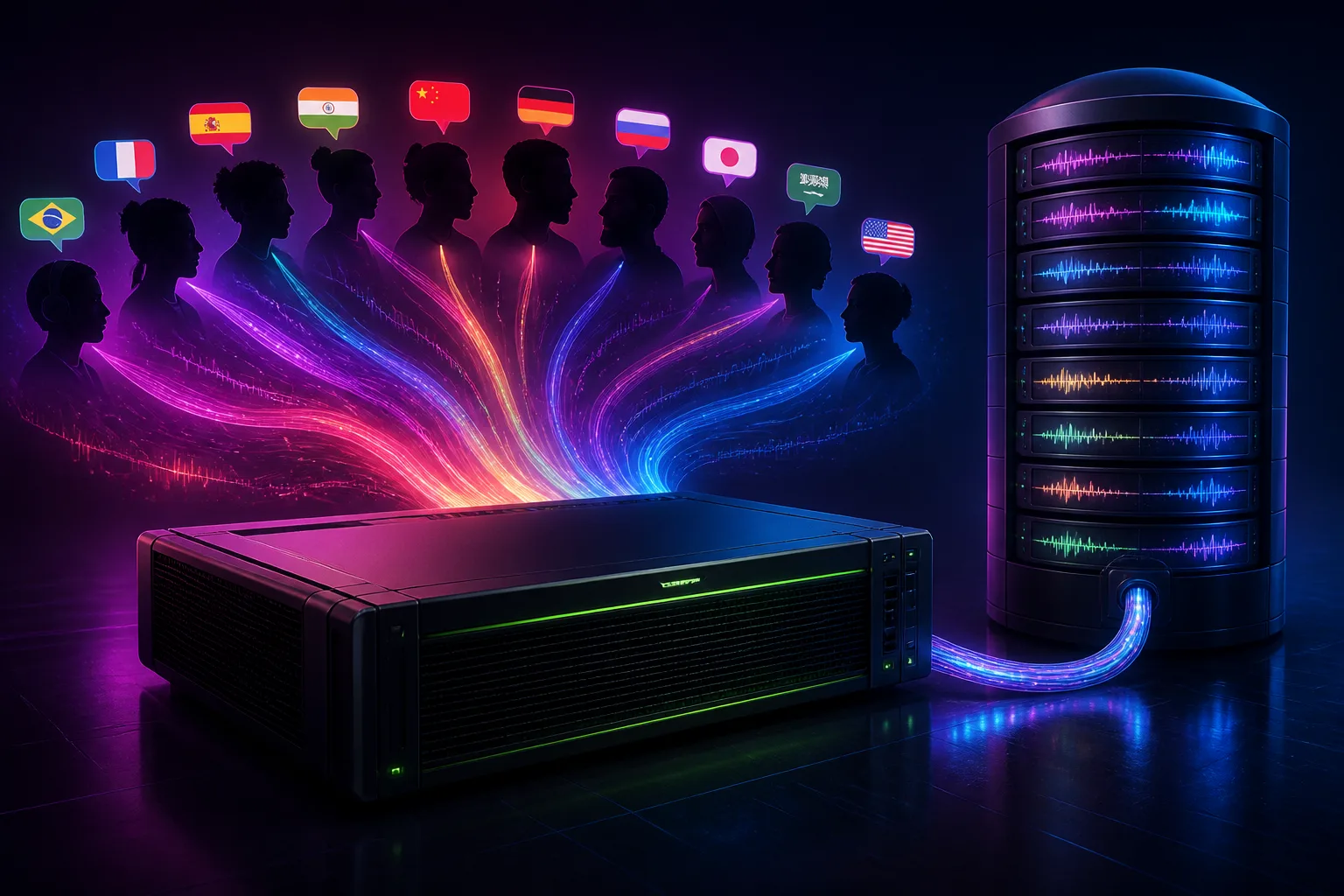
NVIDIA has published Nemotron 3.5 Transcribe, an open-weight, promptable speech model designed to produce transcriptions, speaker labels, translations and audio question-answering from a single checkpoint. The model supports transcription in 40 languages, translation for 31 languages to or from English, speaker attribution in 13 languages, recordings up to one hour, and speaker labeling for up to eight speakers.
Capabilities and benchmark results
Nemotron 3.5 Transcribe combines a speech encoder with a hybrid Mamba–Transformer mixture-of-experts language model so that about 4 billion of its 30 billion parameters are active per token, a configuration NVIDIA says places the model on an accuracy–active-parameter frontier reported by Artificial Analysis. On Artificial Analysis’s AA-WER index, the model ties for first among open-weight systems at 2.8% AA-WER and scores 1.8% WER on the AA-AgentTalk held-out voice-agent set, versus 2.3% for the next-best open-weight model.
On the Hugging Face Open ASR Leaderboard, Nemotron 3.5 Transcribe is reported first among open-weight models for English with a 5.33% average WER; NVIDIA also reports a 4.62% mean WER across seven multilingual test languages and a 10.98% mean WER for long-form audio in the model card’s Open ASR comparison. For speaker attribution, David AI’s DAI-ASR-I18N evaluation lists Nemotron 3.5 Transcribe with the lowest diarization error rate (DER) at 18.26% across 21 languages, narrowly ahead of Nemotron 3 Diarization. VoiceArena’s Diarization-Bench places Transcribe first in cpWER on English full-session tests.
In throughput tests using an NVFP4 quantized build, NVIDIA reports processing 100 hours of audio in under three minutes on a single NVIDIA RTX PRO 6000 Blackwell Server Edition GPU (measured on 30-second clips at high concurrency). Quantized versions and local deployment options for RTX Spark, DGX Spark and Jetson AGX Thor are described as forthcoming.
Granary v2 and adaptation workflow
Granary v2, the open multilingual curation pipeline released alongside the model, provides a public manifest covering 463,062 hours across 48 languages and 16 source corpora. The pipeline produces three transcript forms (verbatim and two inverse-text-normalized variants), task labels, translations with quality scores, and inspectable metadata. Developers can run the NeMo Curator pipeline on private or authorized public corpora and reuse the Granary v2 manifests.
NVIDIA published a NeMo Speech fine-tuning recipe and a medical case study using the Eka Care benchmark. According to those results, a better prompt reduced full-benchmark WER from 30.8% to 23.8% and fine-tuning brought the full test WER to 11.8% on the described mixture. On held-out speakers, fine-tuning reduced WER from 22.44% to 12.17% (a 45.8% relative reduction); keyword WER fell from 9.2% to 6.5% and semantic WER from 10.0% to 7.6%. The adapted model’s 12.17% held-out WER is reported as lower than an open medical-specialist model (13.79%) and a widely used general-purpose ASR model (14.92%).
The Nemotron 3.5 Transcribe checkpoint and Granary v2 manifests are available on Hugging Face and ModelScope. NVIDIA provides deployment guidance for vLLM and mentions hosted endpoints from Baseten, DeepInfra and Simplismart; NeMo Speech.cpp and quantized local builds are announced as coming soon.
Original source: Hugging Face Blog