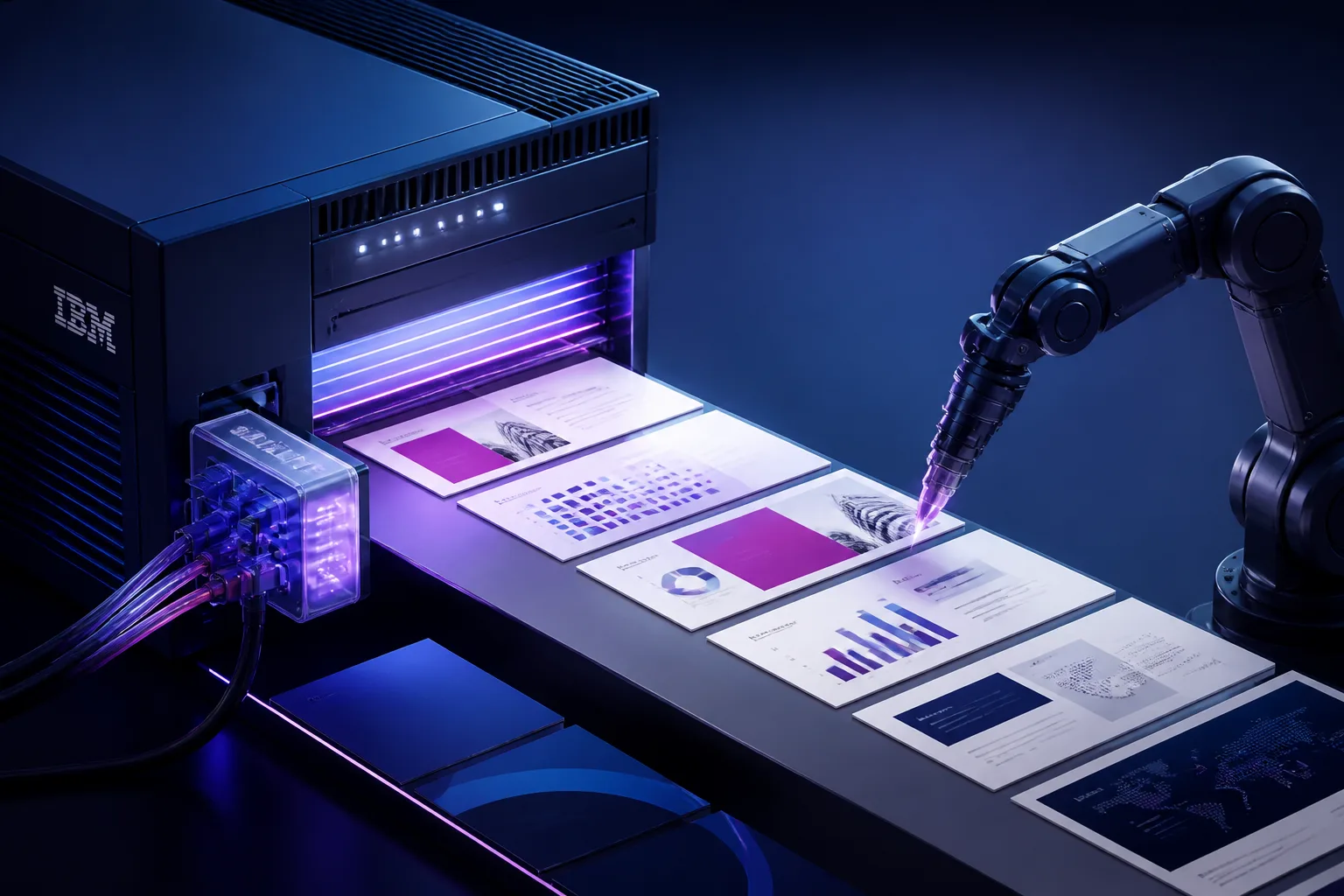
IBM researchers Praveen Venkateswaran, Anupama Murthi and Hamid Adebayo describe Palette, a system that fine-tunes a 20B open-weight model to generate slide decks in a specific design language. The team trained the model on synthetic data that follows the IBM Design Language and wrapped generation with a harness that checks and repairs rendered slides.
Designer and coder roles, implemented with LoRA
Palette divides deck production into two roles implemented as a single LoRA adapter. A “designer” converts a plan into a structured JSON brief that specifies palette, type system, per-slide layout, content and a short rationale. A “coder” consumes one slide’s spec and emits pptxgenjs JavaScript to draw it, preceded by its reasoning about geometry and layout. This split separates editorial judgment from geometric placement and allows slide-level parallel generation.
Training data came from a large open teacher that synthesized about 1,000 decks (roughly 10,000 slides). Each example includes counterfactual reasoning explaining rejected alternatives. During training the team oversampled designer examples because coder examples were about five times longer, which otherwise undertrained the designer role.
Check-and-repair harness and evaluation
Every generated slide is run through a harness that first fixes simple errors (for example malformed color codes), then renders slides to measure overlaps, clipping and overflow. Flagged slides are rewritten by an editor model and accepted only if the checker confirms improvement. Across 131 PresentBench decks the harness increased scores by an average of 3.5 points.
On PresentBench — using plans drafted from source documents by a separate frontier model — the authors report Palette ranks first in Economics and Education, third in Talk, and second on the three-domain mean, placing 1.1 points behind NotebookLM (59.7 vs 60.8) while outperforming other compared systems including Manus 1.6.
The researchers note remaining work: using the harness signals as rewards for reinforcement learning (they mention GRPO-style training), improving handling of figure-heavy decks by extracting figures with tools such as Docling, and exploring reskinning output to match a user’s existing .pptx templates without full retraining.
Original source: Hugging Face Blog