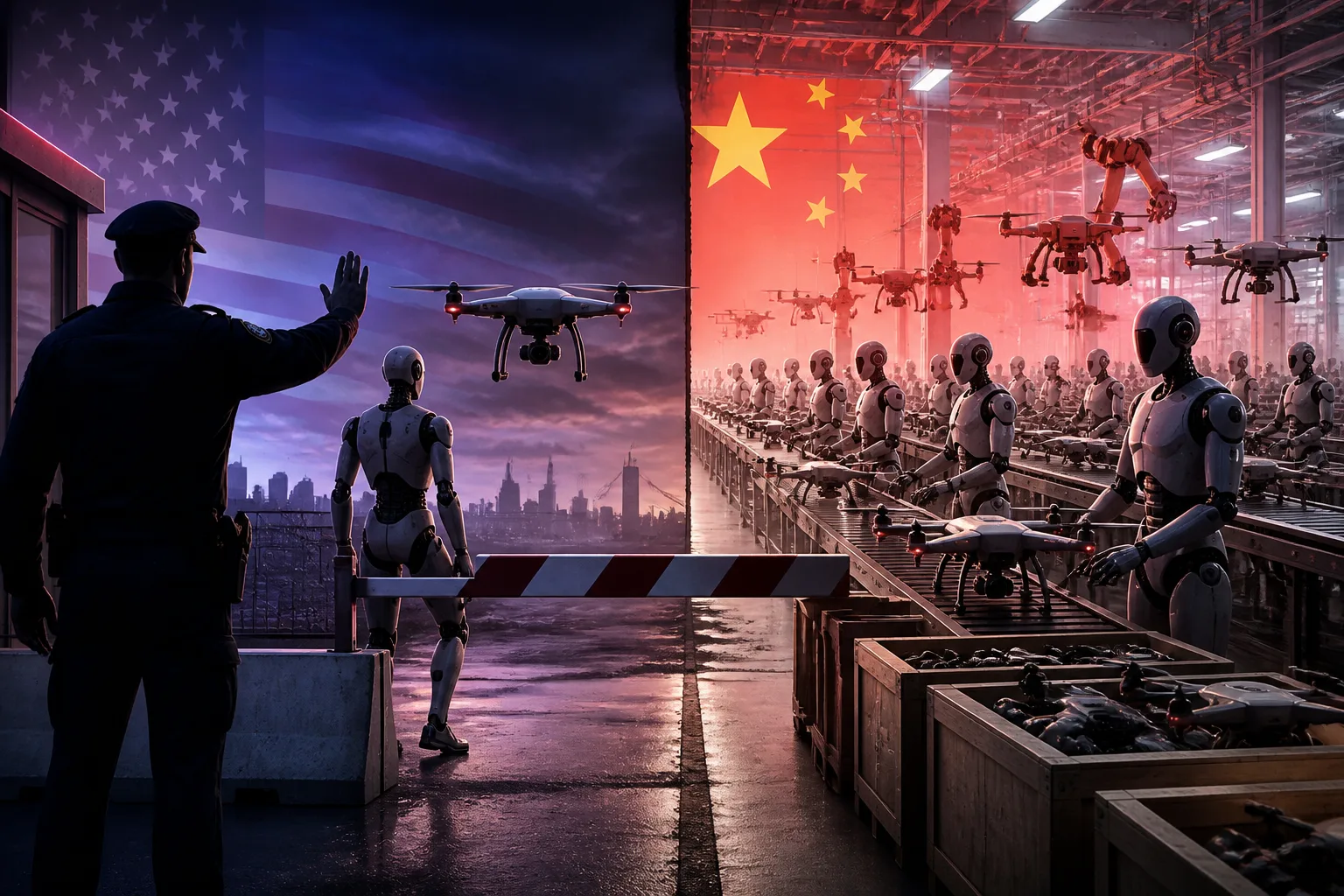
In July and August, U.S. authorities tightened controls on foreign-made advanced robotic systems and imposed steep tariffs on imported drones and their components, citing national-security concerns. The drone tariffs begin in September, with additional component tariffs scheduled for 2027.
Regulatory moves and market reach
The FCC’s Covered List, created in 2021 to target telecommunications and surveillance equipment from Huawei, ZTE and Hikvision, has since expanded to include foreign-made drones and, more recently, advanced robotic devices. The measures aim to limit the entry of certain foreign systems into sensitive U.S. markets.
Industry analysts warn that restrictions affecting Chinese-made drones and humanoids will not erase China’s global manufacturing advantages. “The United States leads in frontier AI, software and semiconductor innovation,” said Ankur Saxena of TDK Ventures. “China leads in manufacturing scale, supply-chain depth and cost.”
Chinese scale and global strategy
Counterpoint reports that Chinese manufacturers accounted for the majority of the roughly 22,000 humanoid robots shipped in the first half of 2026. The five largest makers by shipments—AgiBot, Unitree, Galbot, UBTECH and Leju Robotics—together supplied 86% of global shipments in that period, according to Counterpoint.
Soumen Mandal, a principal analyst at Counterpoint Research, said Chinese firms are reducing costs by internalizing more of the technology stack and leveraging existing manufacturing bases. Unitree is developing more components internally, and automakers such as XPeng are drawing on chip and vehicle experience as they enter robotics.
Analysts and executives expect the effect to be a more fragmented global market rather than a neat U.S.–China split. Bentzion Levinson, CEO of Heven AeroTech, described an emerging two-part industry: a U.S.-led ecosystem of NDAA-compliant systems and a China-led market focused on low-cost, high-volume production. Levinson highlighted power and payload architecture—especially batteries—as the next competitive frontier.
Some see allied supply chains filling gaps: Japan’s industrial-robot experience, South Korea’s electronics and battery strengths, and Taiwan’s semiconductor role. Hyundai (owner of Boston Dynamics) and Toyota are among automakers investing in humanoid robotics.
Agility Robotics welcomed the FCC decision as addressing security concerns and noted its Digit humanoid is designed and assembled in the U.S. Yang Fang of Beagle Technology said robotics may become more regional, with products tailored to local labor needs and working conditions.
Concrete timeline: tariffs on drones take effect in September, with related component tariffs slated for 2027, while global shipment figures reflect the market through the first half of 2026, per Counterpoint.
Original source: TechCrunch AI