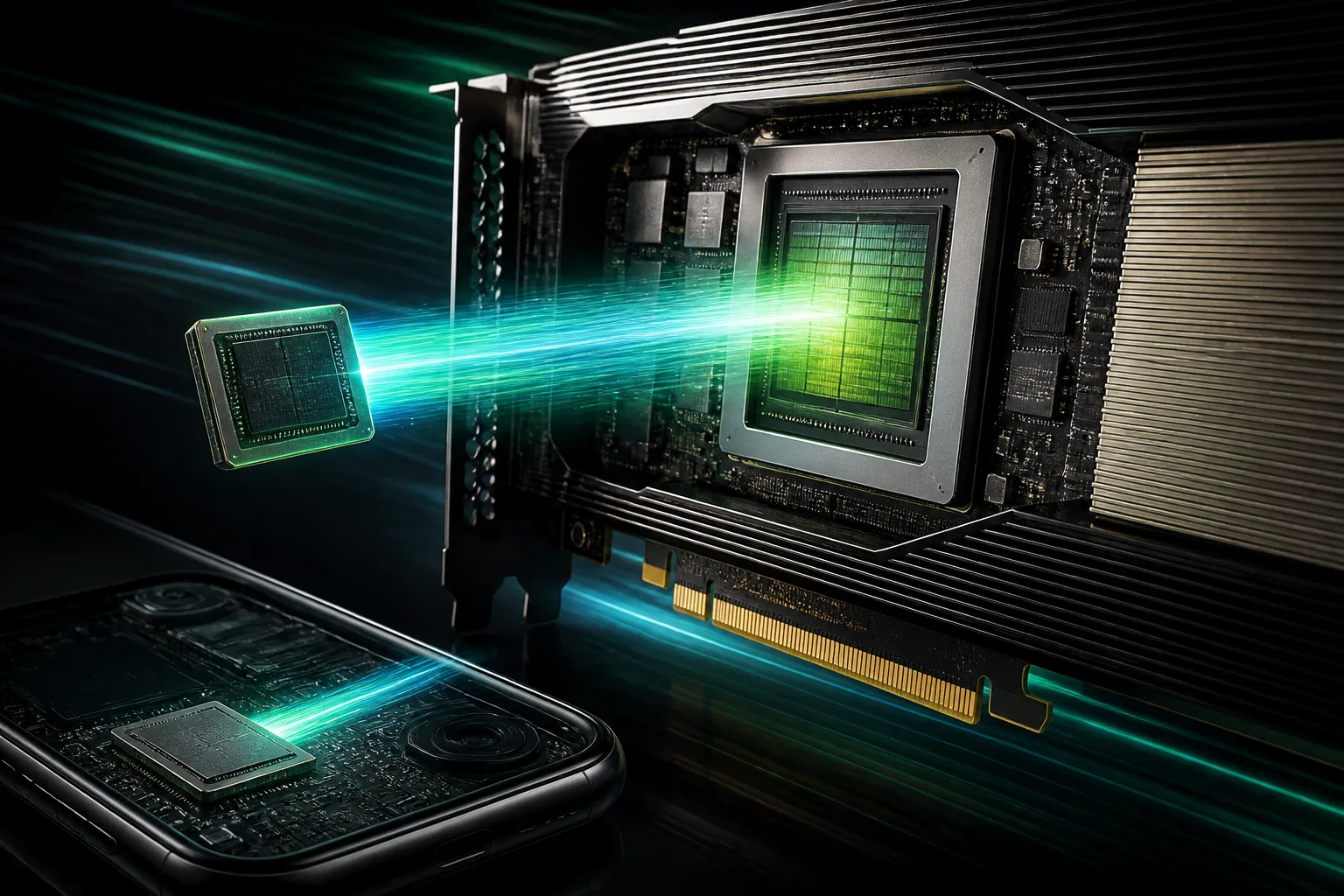
Liquid AI published DSpark draft checkpoints for three members of the LFM2.5 family: LFM2.5-1.2B-Instruct, LFM2.5-2.6B and LFM2.5-8B-A1B. The company reports that the DSpark path trades a small memory increase for faster token decoding, yielding up to 3.18× throughput improvement on an H100 GPU and up to 2.87× on-device.
How DSpark works
According to Liquid AI, DSpark implements speculative decoding: a lightweight draft model proposes candidate tokens and the target model verifies them in a single forward pass. This reduces the memory traffic that often dominates decoding latency by sharing the cost of loading weights across multiple tokens. DSpark combines a DFlash-style parallel backbone conditioned on the target context, a lightweight sequential Markov head to add inter-token dependency, and a confidence-scheduled verifier that prunes low-confidence suffixes.
Liquid AI says the draft models are simplified attention-only decoders with five layers and a block size of nine. Each draft model is roughly ~300M parameters (detailed layer and head counts vary by target model). Training ran for 15 epochs on a mixed dataset covering SFT, chat, code and function-calling data; the released epoch was chosen for highest acceptance rate rather than lowest loss.
Performance across devices and benchmarks
Benchmarks were run on an M4 Max MacBook Pro using FP16 GGUF weights (llama.cpp + Metal, up to 256 output tokens) and on a single H100 80 GB (SGLang, BF16). Measurements used a DSpark block size of 9, batch size 1 and temperature 0. Liquid AI reports mean speedups for LFM2.5-2.6B of about 2.67× on H100 (323 → 864 tok/s) and 2.27× on the M4 Max (61 → 139 tok/s) across five datasets (MATH500, HumanEval, MBPP, GSM8K, MT-Bench).
Reported peak numbers include a 3.18× boost on H100 for LFM2.5-8B-A1B on some datasets, while on-device gains for that model averaged 1.18× due to current MoE behavior in llama.cpp’s Metal backend and increased expert activation when verifying multiple tokens. Liquid AI also states DSpark cuts function-calling latency by 57% on average for LFM2.5-2.6B in multi-tool scenarios.
Availability and usage
DSpark draft checkpoints are published in Safetensors and GGUF formats: LFM2.5-2.6B-DSpark, LFM2.5-1.2B-Instruct-DSpark and LFM2.5-8B-A1B-DSpark (and GGUF variants). Liquid AI provides day-one support for llama.cpp and SGLang; example launch flags were published for both runtimes and include the speculative-draft model path, draft attention backend and spec-type settings. The DSpark block size and draft metadata are read from the draft model config or sidecar metadata during launch.
Original source: Hugging Face Blog