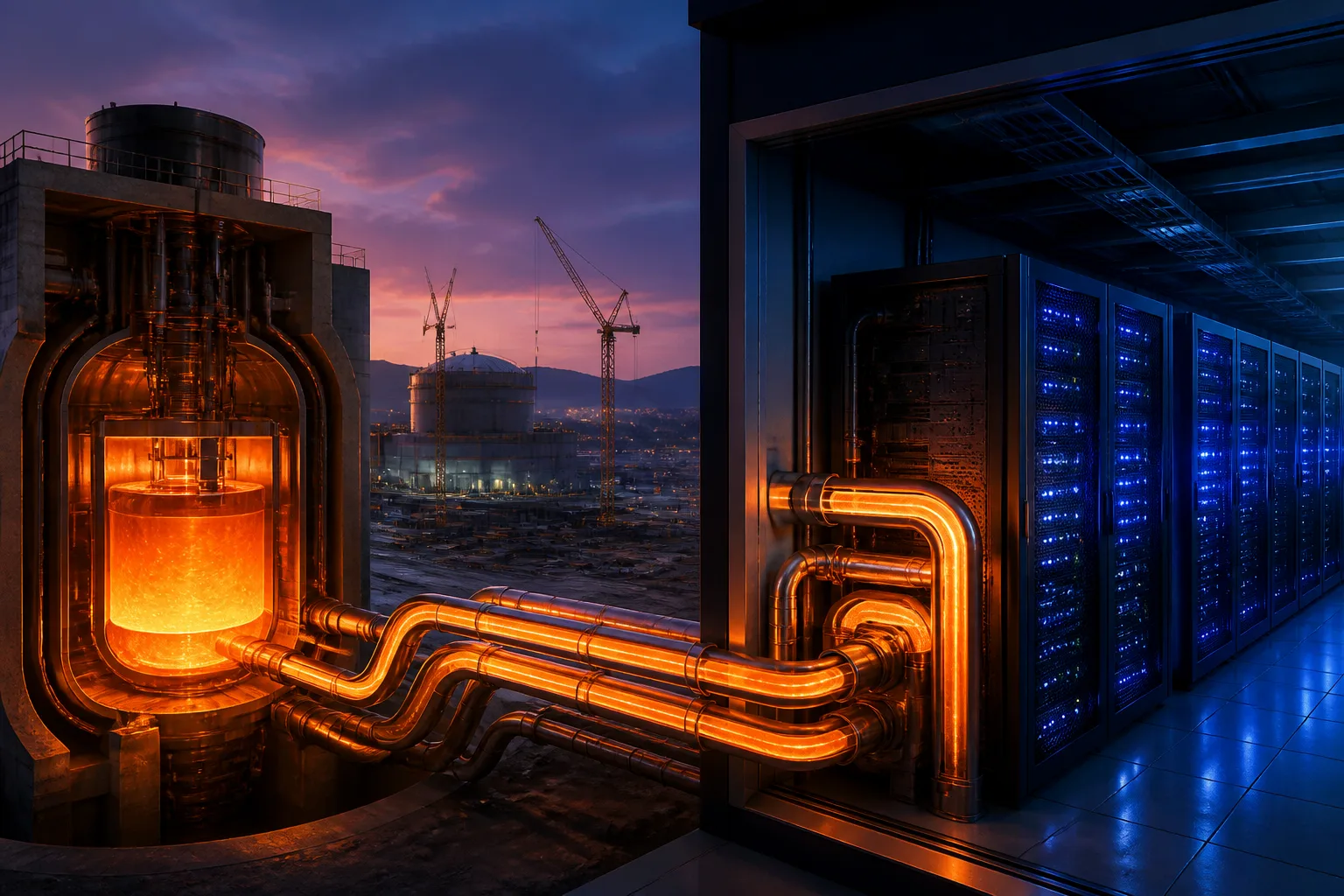
Bloomberg reported that TerraPower plans to announce its first data center project this year, with construction expected to begin in 2027. The company did not disclose the customer; in January it announced Meta had agreed to buy eight Natrium power plants. TerraPower already has a reactor under construction in Wyoming.
Why storage matters for nuclear and AI
Published reporting notes that nuclear reactors operate at high capacity factors in the U.S., generating near maximum power about 92.5% of the time. Existing reactors are slow to change output—about 5% of rated output per minute, according to the National Laboratory of the Rockies—while small modular reactors (SMRs) can adjust faster, roughly 10% per minute by the same measure.
That inertia creates a financial challenge. Nuclear plants carry high capital expenditures, and operating them below full power reduces revenue. Startups developing SMRs expect mass manufacturing could lower capex, but those savings are unproven and, by their own estimates, could take a decade or more to materialize. Early plants are therefore expected to be costly to build and most economical when run near full capacity.
TerraPower’s approach: store heat, not stop the reactor
TerraPower designed a 345-megawatt molten salt‑cooled reactor that pairs continuous reactor operation with a large thermal reservoir. Rather than throttling fission to match short-term demand swings, the plant keeps generating heat and diverts surplus thermal energy into a vat of molten sodium. When demand surges—such as the variable loads of AI training and inference—the stored heat can be released to produce more steam and spin turbines.
The company says this lets expensive reactor equipment run continuously while the storage layer smooths output to the grid or to behind‑the‑meter customers like data centers. Industry reporting also notes that fluctuating data center loads have stressed gas turbines, and operators often add large battery banks to manage peaks and valleys, increasing overall cost.
TerraPower characterizes its design as combining nuclear’s high capacity factor with an energy‑storage buffer that can work alongside intermittent sources such as wind and solar. Bloomberg and company statements provide the project timeline and commercial context: the data center project is expected to break ground in 2027; TerraPower’s first plant is under construction in Wyoming; and Meta agreed in January to purchase eight Natrium plants.
Original source: TechCrunch AI