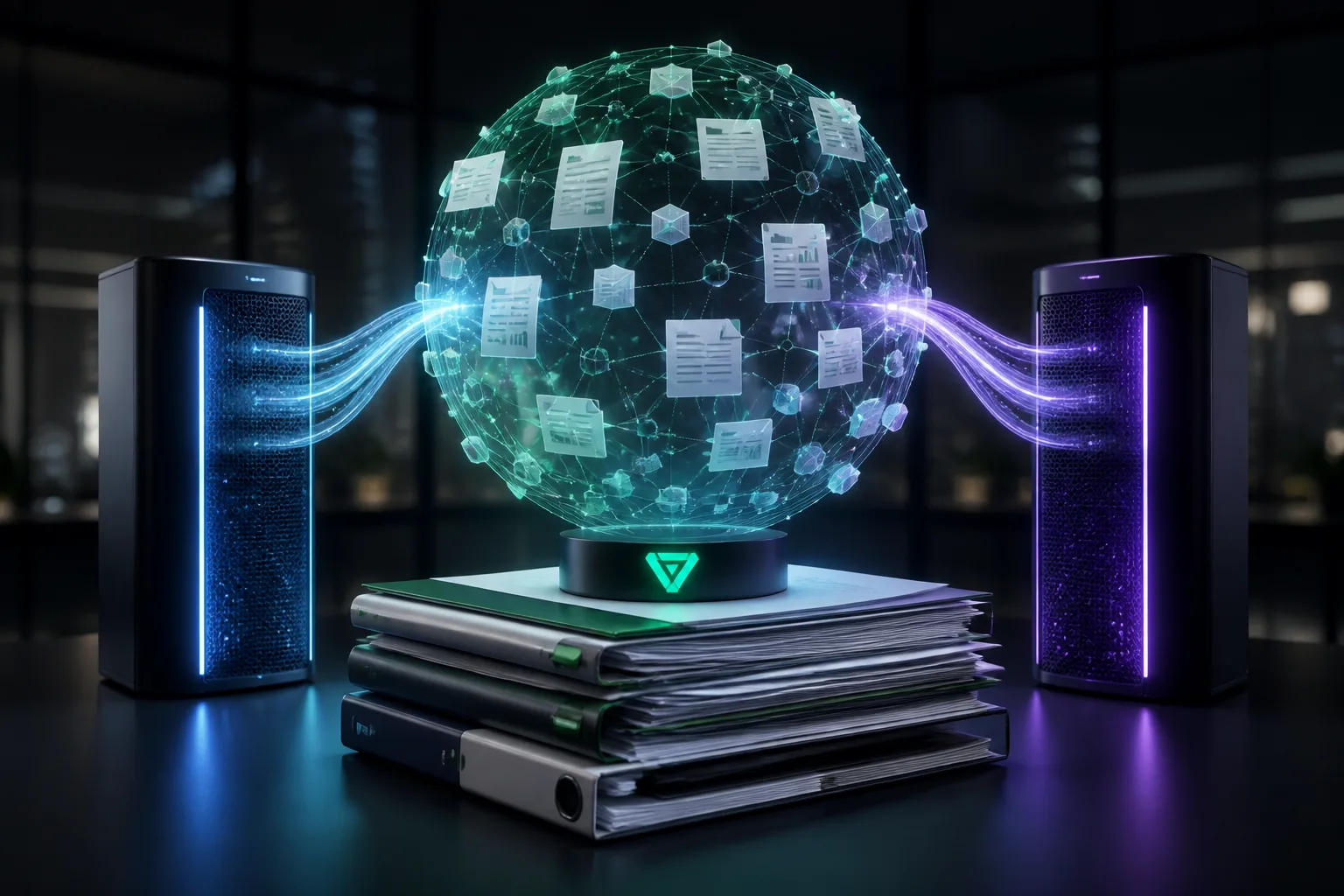
V7 has developed a system that turns scattered company documents into a structured Context Graph so AI agents can access and reuse business-specific knowledge. The company says the graph links entities, relationships and cited evidence drawn from repositories such as SharePoint and Google Drive, and can be queried directly by agents.
How the Context Graph works
According to V7, the platform ingests files, identifies companies, funds, people and other ontology entities, and attaches facts to existing or new records while preserving source citations. When the graph lacks needed detail, V7 Go can still retrieve information from underlying documents with retrieval-augmented generation (RAG).
V7 reported results on the HERB benchmark for enterprise information discovery: its retrieval-only system outperformed the official baseline by 69% and reduced hallucinations on unanswerable queries by 38%, according to the company.
Models, benchmarks and operational metrics
V7 uses OpenAI models across tasks: GPT-5.6 Luna for high-volume extraction, GPT-5.6 Terra and Sol for reasoning and tool use, and GPT-6 Astra for the most demanding Context Graph queries. In a custom, four-level graph-query test, V7 reports GPT-6 Astra reached 89% accuracy on the “very-hard” set, while GPT-5.6 Sol scored 78%; both models were close to 100% on easier levels.
V7 also shared workflow and cost metrics. The company says agents complete 50–100 step workflows in minutes with an auditable trail and cited 99.9% accuracy for those runs. Reported customer outcomes include asset managers screening deals 21x faster, a financial-services team reducing a review from more than 100 hours to under 10 hours (saving $12,000 in expert costs per task), and insurance teams lowering claim-processing errors by 13.5% versus a manual baseline.
On efficiency, V7 reported a 78% lower cost per document with GPT-5.6 Luna compared with GPT-5.4 mini, and said moving document workloads from the Chat Completions API to the Responses API reduced token use by roughly 5% for some PDF-heavy workflows. V7 also reported that GPT-5.6 Sol reduced tool-call error rates from 2.7% with GPT-5.5 to 0.2%.
V7 exposes Context Graph querying and ingestion through its MCP server for use from ChatGPT and Codex, and said it has shortened the time to create a medium-length workflow from about one hour to about 20 minutes. The company is developing reactive workflows that trigger when facts in the Context Graph change and that flag inconsistencies for human review.
“To solve hard enterprise use cases across finance and insurance, AI needs to learn how your business operates just as well as it learned from the Internet,” said Alberto Rizzoli, Co-Founder and CEO at V7. Simon Edwardsson, Co-Founder and CTO at V7, said model improvements and more context have eliminated many intermediate workflow stages and reduced delivery work.
Original source: OpenAI News