Investors and market observers are reassessing Nvidia’s competitive position after the company’s recent earnings, with attention shifting from its GPUs to the wider systems that surround them. Nvidia grew its market capitalization roughly 10x between the start of 2023 and mid-2025, but shares have moderated over the past year amid concerns about GPU competition.
Vera Rubin and rack-level specialization
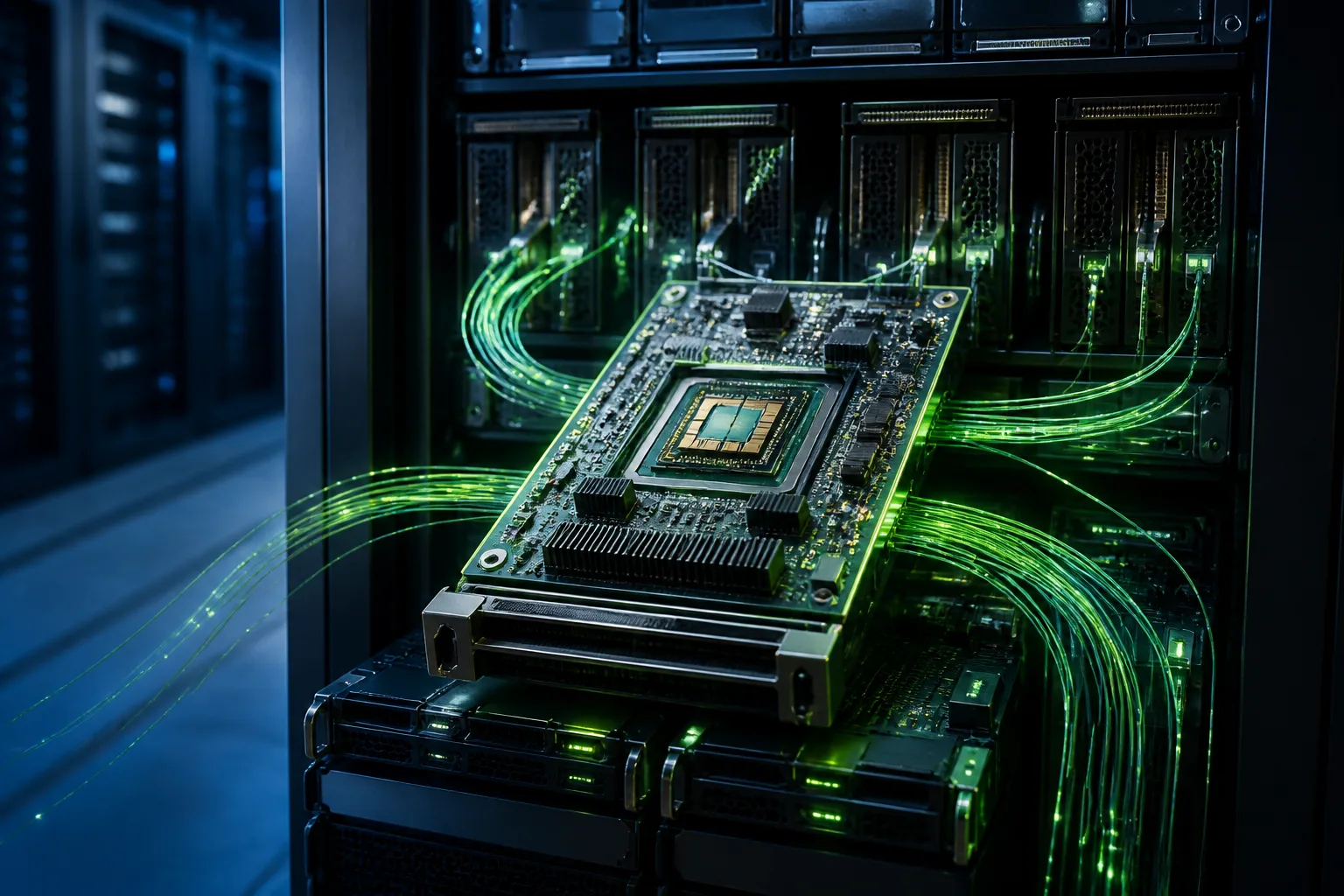
Nvidia is rolling out the Vera Rubin architecture, which pairs the Rubin GPU with complementary units such as the Vera CPU, a Groq 3 LPX inference accelerator and racks designed for storage and networking. Company engineers describe these elements as specialised components that coordinate data movement and hardware resources rather than simply increasing raw token throughput.
Jason Hardy, Nvidia’s VP of storage technology, said the Vera CPU focuses on orchestrating data so GPUs are fed efficiently and flash storage is used without bottlenecks. Hardy reported about a 3x improvement in certain operations when the Vera CPU is used to accelerate traffic coordination.
Orchestration becomes a new layer of competition
As AI compute grows toward gigawatt-scale deployments, operating megascale data centers at peak efficiency becomes more complex, creating opportunities beyond the GPU itself. The need to minimise unnecessary data movement has led other approaches: OpenAI, for example, said its Jalapeño chip was designed to keep workloads within a single connected system to reduce communication delays and data transport.
That divergence — specialised rack orchestration versus integrated chips that limit data movement — opens a new frontier for rivals and hyperscalers. Memory capacity and data routing are increasingly central; industry suppliers such as Micron benefited from rising memory demand in the recent infrastructure wave.
Nvidia still faces competition from other chipmakers and hyperscalers, but company systems that coordinate compute, memory and I/O are now a major part of its value proposition. Market participants are watching whether rivals can match end-to-end orchestration as deployments scale and latency and power efficiency requirements tighten.
Original source: TechCrunch AI